Axum is one of the most important archaeological landscapes in sub-Saharan Africa. A sacred city, a UNESCO site, and the historical centre of a civilization that for centuries connected Africa, the Mediterranean, and the Middle East, Axum continues today to be a place of great historical and cultural significance for Ethiopia and for the world.
In recent years we had the opportunity to work on a feasibility study for the improvement of the Axum archaeological site and the city’s cultural services, within the framework of a project promoted by the Italian Agency for Development Cooperation (AICS) and developed in collaboration with the Ethiopian Heritage Authority and with Ethiopian professionals and institutions.
One of the central nodes of this work concerns the vision for the future of the Axum Archaeological Museum.
The current museum, built between 2005 and 2006 within the Ethiopian Cultural Heritage Project, is in a strategic position next to the Stelae Park and close to some of the most significant places of the historic city. Over time it has become not only a space for conserving archaeological finds, but also a meeting place for the local community: a cultural centre that hosts exhibitions, gatherings, events, and educational activities.
At the same time, recent years have made some critical issues evident: maintenance problems, exhibition layouts now outdated, exhibition paths that are difficult to read, and above all the consequences of a regional context marked by instability and conflict.
This scenario opened an important question: how can a museum like the one in Axum continue to fulfil its cultural, educational, and social role in such a complex context?
A project built together
The proposal developed by our team starts from a simple principle: any intervention on the museum must begin from the local context and the community that inhabits this heritage every day. For this reason the work was built through constant dialogue with:
- the Ethiopian Heritage Authority
- Ethiopian professionals and technicians
- local institutions and cultural operators
The aim was not to imagine an “imported” museum, but to strengthen an existing structure so that it can work better for the territory, for visitors, and for the city’s educational activities. The museum thus becomes not only a place of conservation, but a space where the community can recognize itself, tell its own story, and pass it on to future generations.
Materials, colours, and cultural landscape
The architectural and museographic concept was developed by Massimiliano Lipperi and his team, starting from a careful observation of the architecture, materials, and visual languages typical of the Axumite tradition. The starting point was a study of the context that considered:
- locally available materials
- traditional building techniques
- colour palettes present in Axumite objects and artistic traditions
- architectural geometries typical of Axumite culture
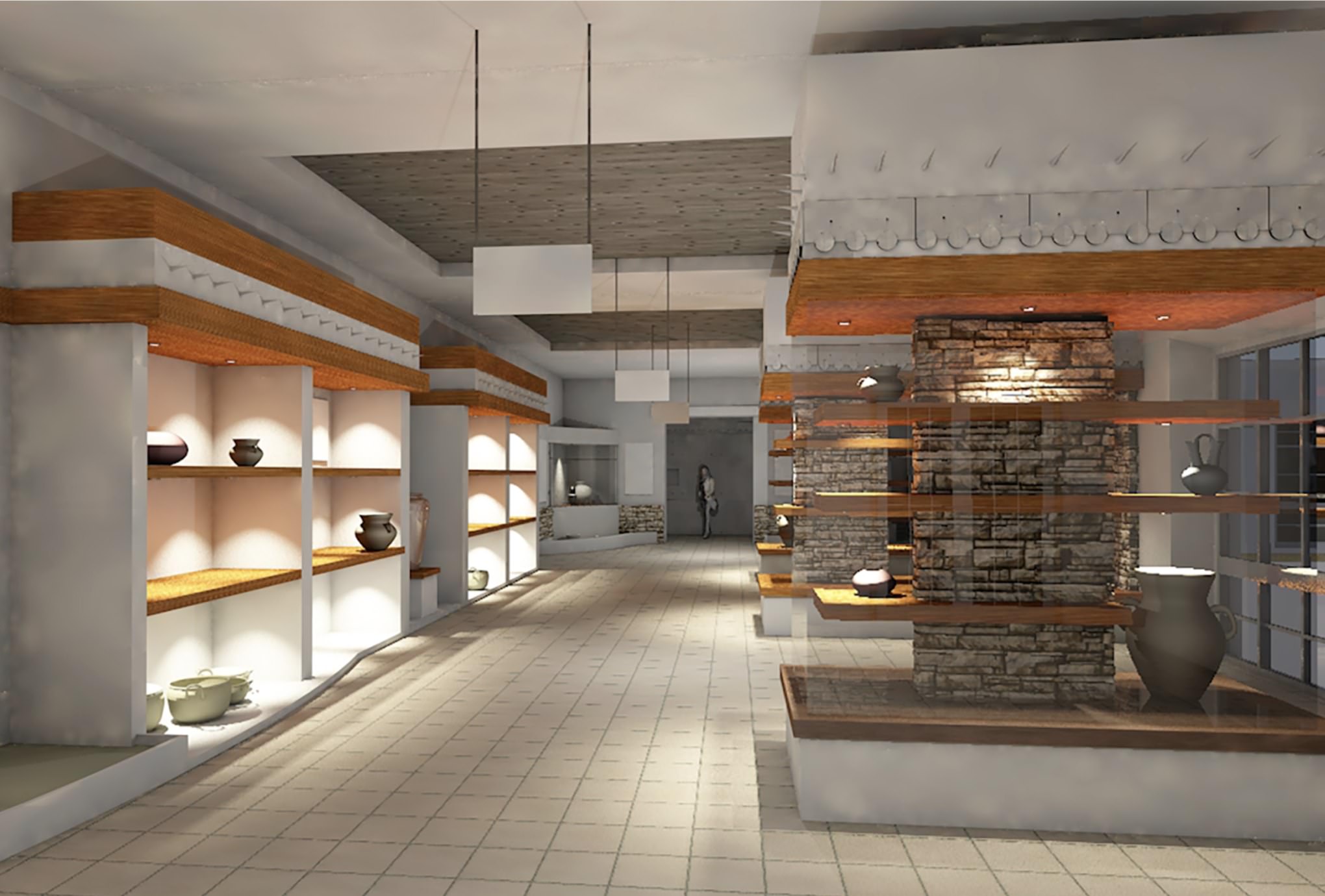
These elements become the basis for the design of the exhibition spaces, graphics, and museographic installations. The result is a vision that seeks to reconcile contemporaneity with rootedness in the historical context, avoiding solutions that are foreign to the city’s cultural landscape.
Many of the works planned for the project are also conceived to be carried out directly in Axum or in the region, while only some more specialized technological components will be produced in Addis Ababa.
Drawing before modelling
One of the most fascinating aspects of the design work concerns the creative process that led to the definition of the spaces.
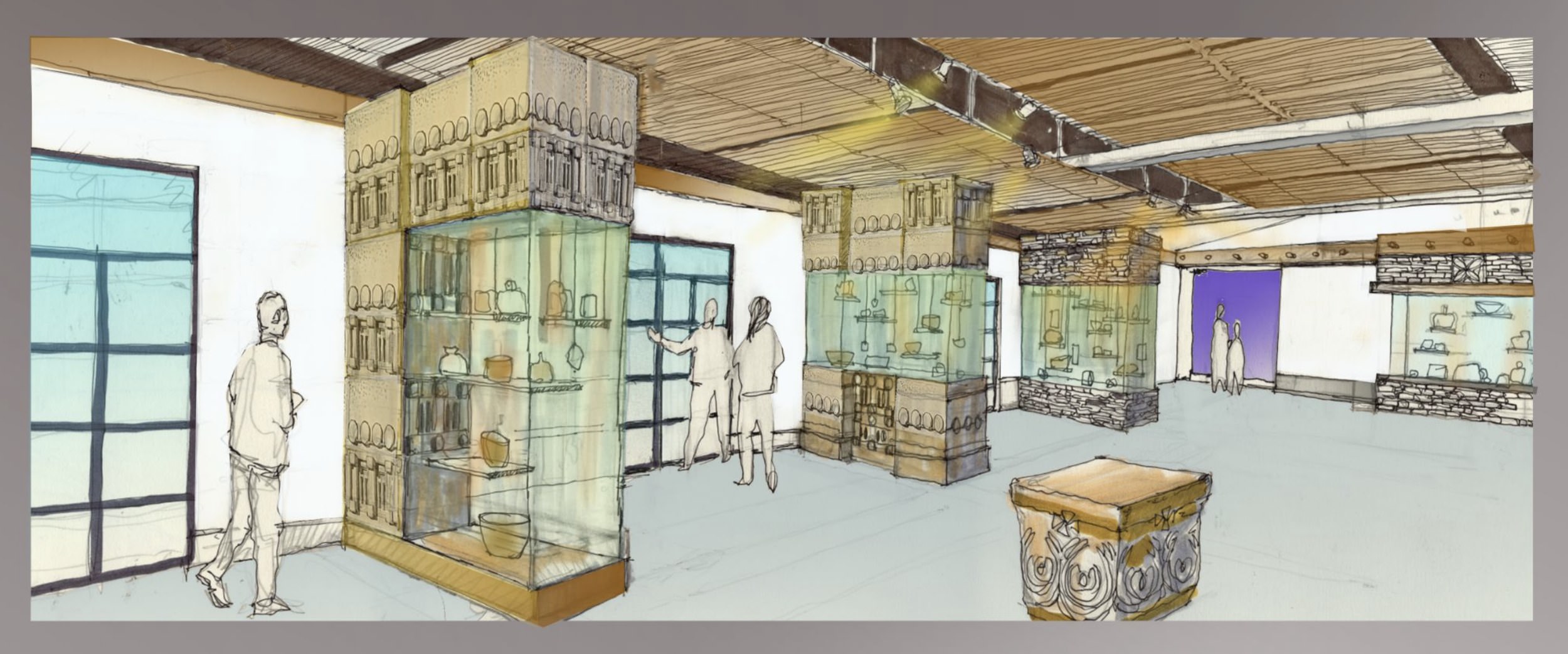
Before the three-dimensional models and the digital simulations, the project was born from a series of hand sketches made by Massimiliano. These drawings explore volumes, paths, and spatial relationships, but above all they try to translate visually a fundamental question: how can a museum tell the story of Axum while remaining coherent with its cultural landscape?
In a historical moment in which the architectural project is almost entirely digital, these sketches are a reminder that the first instrument of design thinking often remains the simplest: a pencil, a sheet of paper, and the time needed to observe.
A museum path to tell the story of Axum
The proposal for the reorganization of the museum envisions an exhibition path articulated in six thematic sections, designed to guide the visitor through the history of the region. The path takes the public:
- from the territorial and archaeological context of Axum
- to the pre-Axumite phases
- to the Axumite period, the moment of greatest development of the local civilization
- to the subsequent transformations
- through to the most recent cultural expressions of the region
Stage installations inspired by the Axumite stelae, lighter exhibition systems, and new audiovisual technologies will make it possible to tell the story not only of the archaeological finds, but also of the cultural landscape and the social history of the territory. The objective is to make the museum more legible, more engaging, and more accessible, especially for schools and for the city’s educational activities.
Culture, resilience, and future
In recent years Axum, like many other regions of Ethiopia, has gone through difficult moments. In a context marked by conflict, economic instability, and major social challenges, talking about museums may seem secondary. And yet it is precisely in these moments that cultural heritage reveals its deepest value.
Places of memory, knowledge, and identity become spaces where communities can continue to recognize themselves and to imagine the future.
The work on the Axum Archaeological Museum is born of this conviction: that even in the most fragile contexts culture remains one of the most important infrastructures for community resilience.
Our contribution has been to put competence, listening, and design at the service of this extraordinary heritage, working together with the Ethiopian partners to imagine a museum capable of telling the story of Axum today and tomorrow.