Cultural heritage is no longer only the custody and conservation of the past: it is a dynamic, complex, and expanding professional field. In a world that is rapidly transforming under the pressure of digitalization, public participation, new technologies, and accessibility demands, an urgency arises for new skills and professions, which are redefining what it means to work with cultural heritage today.
Heritage as a multiple workspace
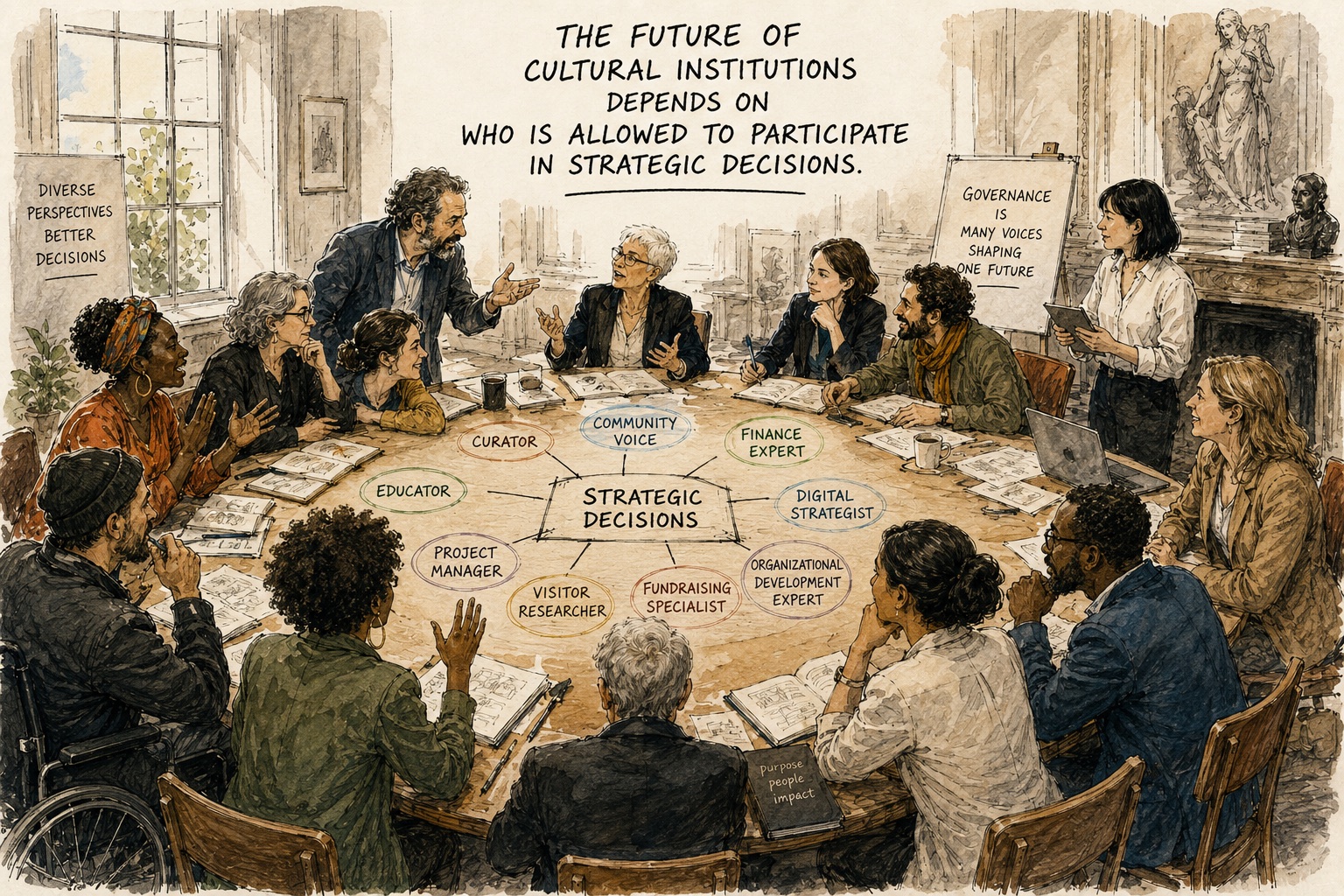
Until recently, work in cultural heritage was associated mainly with figures such as conservator-restorers, archaeologists, art historians, or museum officers. Today, instead, the plurality of roles required has emerged with force: from cultural project management to project management, from creative content writing to digital strategy, from public mediation to participatory governance, all the way to the creation of immersive and narrative experiences. Many of these figures are the result of the encounter between traditional cultural skills and transversal skills such as technology, design, communication, management, and data science (https://dicolab.it/).
Digitalization in particular has expanded the very concept of heritage: it is no longer only “objects” to be protected, but data, experiences, narratives, and interactions to be designed, managed, and made available to ever wider and more diverse communities. In this sense, disciplines such as digital humanities, digital cultural heritage, and the user’s digital experience are emerging as autonomous and transversal sectors of work (https://pro.europeana.eu/).
Transversal skills and frontier roles
An interesting reading on the new transversal skills in the cultural field is the “Mapping of emerging cultural professions and their training paths” by the Fondazione Compagnia di San Paolo. Some of the modern professional figures most in demand and expanding in cultural heritage include:
- Cultural project manager — integrates skills in management, planning, financing, and leadership of complex projects
- Digital strategist / Digital transformation manager — guides processes of digital innovation and strategies for technological access
- Content creator and digital storyteller — translates cultural content into narratives that work on online, social, and immersive platforms
- Audience engagement and UX expert for heritage — designs experiences that put the user and their needs at the centre
- Cultural data analyst / data manager — works with cultural data for research, interpretation, and valorization
- Cultural community manager and networker — builds relationships and networks among publics, institutions, local communities, and stakeholders
- European project designer and fundraiser — integrates funding and project-design skills to access national and international funds
- Facilitator of shared processes — helps institutions and communities to co-design sustainable solutions.
These figures are not just “new labels”: they represent a professional morphogenesis, that is, an expansion of the skills professionals must master to navigate a complex ecosystem where culture, technology, economy, and community intersect. On this point, a good read is the “Report: Guidelines on innovative/emerging cultural heritage education and training paths” by the European Cultural Heritage Skills Alliance.
Why this transformation?
The transformation of professions in cultural heritage is not random. Some key factors are:
1. Widespread digitalization The creation, management, interpretation, and use of digital content requires new skills: from data analysis to immersive platforms, including crowdsourcing tools and augmented reality.
2. Participation and accessibility Working with communities, making places and content accessible and inclusive, and designing participatory and non-excluding experiences have become fundamental criteria (the example of the CCR – Centro Conservazione e Restauro dei Beni Culturali La Venaria Reale is excellent).
3. Interdisciplinarity The combination of humanistic skills with technical and social ones is creating hybrid roles in which cultural knowledge integrates with design, communication, technology, and organization.
Looking beyond: heritage as a space of meaning
In cultural heritage the future is not simply “more technology” or “more work”: it is the possibility to rethink how and why heritage enters people’s lives. Emerging professions are not just new labels for jobs, but springboards of meaning: they connect stories, technologies, communities, narratives, and organizational processes.
In this sense, the new unity of cultural work is not only technical or managerial: it is reflective, creative, social, and design-driven all at once.
Resources and references
To explore these trends and skills further, you can start from the following sources and initiatives:
- Digital professions in the cultural sector — overview of evolving professional profiles between culture and digital.
- Report on emerging cultural professions — detailed mapping of multi-sector roles and skills.
- Young Professionals Forum — focus on skills for cultural accessibility and engagement.
- Academic programmes and research on digital cultural heritage — examples of international training in new fields.